Thursday, February 13, 2014

Chapter 9 : Enabling the Organization Decision Making

Hello :) So before we great the weekends...i would first like to briefly explain a new chapter that is chapter 9 : Enabling the Organization Decision Making. Let get right to it!!

Making Business Decision:

The Decision- Making Process
It plays a crucial role in communication and leadership for operational, managerial, and strategic projects. There are numerous academic decision-making models....here is one example... 

 Decision-Making Process.....


Decision-Making Essentials
The structure of a typical organization is similar to a pyramid and the different levels require different types of information......


Support: Enhancing Decision Making with MIS


This is the models information to support managers and business professionals during the decision-making process.


 here is a video to explain this topic even clearer.. 


Lastly is The Future: Artificial Intelligence (AI)....in a nutshell AI is a stimulation of human thinking and behavior in machines and systems.


There are 5 main types:
  1. Expert systems
  2. Neural networks
  3. Genetic algorithms
  4. Intelligent Agents
  5. Virtual reality.


- THE END-

Monday, February 3, 2014

Chapter 8 : Accessing Organizational Information - Data Warehouse

Accessing Organizational Information
The company also uses data warehouse information to perform the following:
              ·         Base labor budgets on actual number or guests served per hour. 
·         Develop promotional sale item analysis to help avoid losses from overstocking or  under stocking inventory. 
·         Determine theoretical and actual costs of food and the use of ingredients.

 History of Data Warehousing
Operational systems typically include accounting, order entry, customer service, and sales and are not appropriate for business analysis for the following reasons:
·         Information from other operational applications is not included.
·         Operational systems are not integrated, or not available in one place.
·         Operational information is mainly current—does not include the history that is required to make good decisions.
·         Operational information frequently has quality issues —the information needs to be cleansed
·         Without information history, it is difficult to tell how and why things change over time.
·         Operational systems are not designed for analysis and decision support.

Data Ware house Fundamentals
A data warehouse is a logical collection of information—gathered from many different operational databases—that supports business analysis activities and decision-making tasks.
Extraction, transformation, and loading (ETL), which is a process that extracts information form internal and external databases, transforms the information using a common set of enterprise definitions, and loads the information into a data warehouse.

 MULTIDIMENSIONAL ANALYSIS AND DATA MINING
A cube is the common term for the representation of multidimensional information.

 Data mining is the process of analyzing data to extract information not offered by the raw data alone.
Date-mining tools use a variety of techniques to find patterns and relationships in large volumes of information and infer rules from them that predict future behavior and guide decision making.

 INFORMATION CLEANSING OR SCRUBBING
Information cleansing or scrubbing is a process that weeds out and fixes or discards inconsistent, incorrect, or incomplete information.

 Business Intelligence
Business intelligence (BI) refers to applications and technologies that are used to gather, provide access to, and analyze data and information to support decision-making efforts.
A certain school of thought draws parallels between the challenges in business and those of war, specifically:
·         Collecting information.
·         Discerning patterns and meaning in the information.
·         Responding to the resultant information.
 
ENABLING BUSINESS INTELLIGENCE
Technology – the most significant enabler of business intelligence.
People – Understanding the role of people in BI allows organizations to systematically create insight and turn these insights into actions.
Culture – A key responsibility of executives is to shape and manage corporate culture.

Sunday, February 2, 2014

Chapter 7: Storing Organizational Information- Databases


  Goodmorning !
 Hope everyone had a prosperous Chinese New Year. Today i shall be explaining briefly about storing information (database). Lets get started! :D 

Storing Organizational Information....

      The computer program used to manage and query a database is know as a database management system (DBMS). The basic concept of database is a collection of records, or pieces of information.

Relational Database Fundamentals......

From previous chapters we have conclude that information is every where, and they are stored in the formed of database.
Database: maintains information about various types of objects(inventory), events (transaction), people ( employees) and places (ware-house).
Database includes:
Hierarchical database model – information is organized into a tree-like structure (using parent/child relationships) in such a way that it cannot have too many relationships. 

Network database model – a flexible way of representing objects and their relationships.

 Relational database model – stores information in the form of logically related two-dimensional tables


Entities and Attributes...

 Entity is the relational database model is a person, place, thing, transaction, or event about which information is stored.    The rows in each table contains the entities 
 Attributes (or known as fields and columns) are characteristics or properties of an entity class. The columns in each table contain the attributes

Keys and Relationships.....
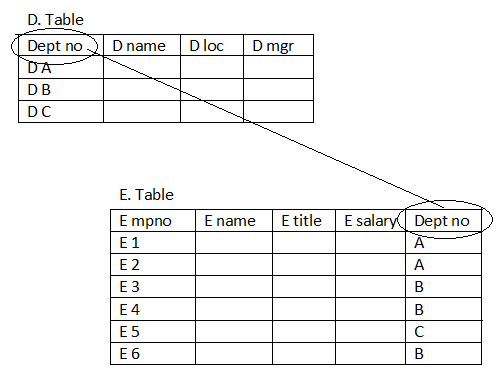
-    Primary keys and foreign keys identity the various entity classes (tables) in the database;

 Primary key – a fields (or group of fields) that uniquely identities a given entity in a table
  Foreign key – a primary key of one table that appears an attribute in another table and acts to provide a logical relationships among the two tables
 

Relational Database Advantages.....

INCREASED FLEXIBILITY
 
-     A well-designed database should;
1.  Handle changes quickly and easily
2.  Provide users with different views
            3.  Have only one physical views
                 (deals with the physical storage of information on a storage device
            4.  Have multiple logical views
                 (focuses on how users logically access information)
 
INCREASED SCALABILITY AND PERFORMANCE
-      A database must scale to meet increased demand, while maintaining acceptable performance levels
1.  Scalability – refers to how well a system can adapt to increased demands
2.  Performance – measures how quickly a system performs a certain process or transaction
REDUCED INFORMATION REDUNDANCY
-      Databases reduce information redundancy (the duplication of information or storing the same information in multiple places). However, inconsistency is one of the primary problems with redundant information.
INCREASED INFORMATION SECURITY
 
-      Information is an organization asset and must be protected.Databases offer several security features including;
  i.  Password – provides authentication of the user
 ii.  Access level – determines who has access to the different types of information
            iii. Access control – determines types of user access, such as read-only access

Database Management System....

 Database management systems (DBMS) – software through which users and application programs interact with a database
 
 Data-Driven website business Advantages

 
 Integrating Informational Among Multiple Databases ...
An integration  it allows separate systems to communicate directly with each other. There are two types of intergration.....  

1.   Forward integration – takes information entered into a given system and sends it automatically to all downstream systems and processes


          2.  Backward integration – takes information entered into a given system and sends it automatically to    all upstream systems and processes


- The End-


Thursday, January 16, 2014

PROJECT FOCUS

Norzulaiha Bt. Alias
Noor Asniza Bt. Asmaddin
Ayuliza Bt. Kasim
Nurul Aisyah Bt. Ahmanul
Nur Atila Bt. Abdul Rahman
Putri Azizuhainee Bt. Mohd. Khalid
 
Question :
We know that people use information technology to work with information. Knowing this, how could these types of errors occur? What could happen if you decided to use Facebook to collect information intelligence for a research paper? What could Facebook do to help prevent these types of errors?
 
Here are some references to determine whether the information obtain is a good or bad; 


Problems that may occur:
 
     Facebook is a website that is generally open to all.  The information can be easily falsify and does not need to be filtered. Thus, why the information is not credible for the use of a research. The information obtain may not be true or valid and may not be based on facts. Furthermore, the information at facebook may be biased as it is based on ones opinion and perception. Lastly, we have no way to insure that the information that is posted on facebook is valid as for we do not know the sources of information and its credibility.
 
Prevention that Facebook may do to prevent these problems:
Facebook should filter the information posted on their website or increase its security by valuating its information and sources.
 

Tuesday, January 14, 2014

Chapter 5 : Organizational Structures That Support Strategic Initiatives.

Good afternoon :) 
 

Today's agenda in to expose our self with the structure that supports our strategic initiatives based on the previous chapters.....shall we dive in? :D

Lets begin with IT roles and responsibilities;

Chief Information Officer (CIO)- these people are responsible to oversee all uses or IT and ensures the strategic alignment of IT with business goals and objective. The CIOmreports direct to CEO. A broad function of CIO includes manager, leader and communicator.  
Chief Technology Officer (CTO)- CTO responsible for ensuring the throughout, speed, accuracy, availability, and reliability of an organization’s information technology.  Similar to CIOs but CIOs take on the additional responsibility usefulness of ensure that IT is associated with the organization’s strategic initiatives.
 
Chief Privacy Officer (CPO)-  For the CPO they are responsible for ensuring the ethical and legal use of information. This role is regarding the use of personal information, including medical data and financial information, and laws and regulations. 
 
Chief Knowledge Officer (CKO)-CKO responsible for collecting, maintaining and distribution the organization’s knowledge. Those who hold this position have to manage intellectual capital and the custodian of knowledge management practices in an organization.

Chief Security Officer (CSO) - The CSO generally serves as the business leader responsible for the development, implementation and management of the organization’s corporate security vision, strategy and programs. They direct staff in identifying, developing, implementing and maintaining security processes across the organization to reduce risks, respond to incidents, and limit exposure to liability in all areas of financial, physical, and personal risk; establish appropriate standards and risk controls associated with intellectual property; and direct the establishment and implementation of policies and procedures related to data security.


Gap Between Business Personnel And It Personnel

It exist because presence of perception business people that the Information Technology Department
generates expenses not income. Thus making them look more like a liability. In the same
time, The Information technology department is “hidden” from the customer often classified as a
“back office” business initiative or process. This create a different perspective to the business
personnel and the result, a gap is exist. 

How do we fix this issue you might ask....


through....

 Communication
#  Communication is the main ingredient that will close the gap between the business personnel and the IT Department. Business leaders must understand, really understand, that  Information Technology is not optional but critical to the success of the business. 
#  The head of the company sets the tone for the entire business. 
#  In addition IT department teams need to understand the business practices of the company.
 Now lets go to the fundamentals of Ethics & Security... 
  
ETHICS
Ethics is the principle and standards that guide our behavior toward other people.
Descriptive ethics is exactly that a description of "what is"       in the land of business ethics.  This
perception seeks to recognize moral & ethical systems shared by people, cultures, and
societies.  This form seeks to know prevailing views and actions about ethical performance.  One
problem to this school of thought is that using this perspective may lead one to believe that an
actual unethical behavior is satisfactory because "everyone is doing it."
 
 Issues Affected By Technology Advances : 
i) Intellectual property - Intangible creative work that is personified in physical form.
ii) Copyright - The legal protection afforded an expression of an idea, such as a song, video   game, and some types of proprietary documents.
iii) Fair use doctrine - In certain situations, it is legal to use copyrighted material.
iv) Pirated software - The unauthorized use, duplication, distribution, or sale of copyrighted software.
v) Counterfeit software - Software that is manufactured to look like the real thing and sold as such. 
 
SECURITY
    Security is a major ethical issues. The right to be left alone when you want to have control over your own personal possessions and not to be observed without your consent.
before I end this blog here is a website that helped me a lot in understanding this chapter better :)
https://sites.google.com/site/qccrdesir/unit-1/chapter-5---organizational-structure-that-support-strategic-initiatives

HAVE A NICE DAY! :d

Monday, January 13, 2014

Chapter 4: Measuring the Success of Stratigic Initiative.

Hai again, this is just another post :) 
Shall we just jump right into the chapter?


To begin with, one should know that IT success is EXTREMELY difficult to measure. 
"How does a company identifies the success fulness of a strategic initiative?"
The answer lies in the metrics...Key performance indicators (KPIs) is the measures that are tied to business drivers. Thus metrics are the detailed measures that feed theso KPIs.

EFFICIENCY & EFFECTIVENESS

=> Efficiency IT metrics, measure the performance of the IT system itself including throughput,speed, and availability.

=>  Effectiveness IT Metrics, measure the impact IT has on business process and activities including customer satisfaction, conversation rates, and effectiveness.


In a nutshell, effectiveness focuses on how well we achieve our goals and objective, whilst efficiency focuses on the optimal way use the resources.  

THE INTERRELATIONSHIP OF EFFICIENCY AND EFFECTIVENESS IT METRICS.


Most managers are familiar with financial metrics but unfamiliar with information system metrics. These are the metrics that will help managers measure and manage their strategic initiative....   

Website Metrics..


 Supply Chain Management (SCM)

 Customer Relationship Management (CRM) Metrics


Business Process Reengineering(BPR) and Enterprise Resources Planning(ERP) Metrics

for this strategic initiative the method to measure is the.....

 balance scorecard - a management system, in addition to a measurement system, that enables organizations to clarify their vision and strategy and translate them into action


that is it for this chapter :) have a great day!

chapter 3 : Strategic Initiatives for Implementing Competitive Advantages

Well hello again :)
 So today's blog is about introducing high-profile strategic initiatives that an organization can undertake to help it gain competitive advantages and business efficiencies.

First and foremost is....

SUPPLY CHAIN MANAGEMENT(SCM).

- Beforehand, i should probably explain what is a supply chain...A supply chain is every activity and party involved in the process of fulfilling the order of a customer from the raw materials to the delivery of goods to customers.
- Supply chain management or better known as SCM is the management of information flows between and among stages in a supply chain to maximize total supply chain effectiveness and
 profitability.
-These are the 4 basic components of SCM :


- The most important facts is that, the effectiveness and efficiency of SCM can enable an organization  to:
1. DECREASE buyers power.
2. INCREASE suppliers power.
3. INCREASE switching powers.
4. INCREASE  barriers to entry.
 

Next we have the......

CUSTOMERS RELATIONSHIP MANAGEMENT(CRM)

 - Well in a nutshell, Customers Relationship Management involves managing every aspects of a customer's relationship. It allows the organization to identify customers, design specific marketing campaign, understand their behavior individually. Thus generates loyalty within their customers.

- With CRM customers can contact the organization through various type of technology such as cell centers, web access, email and many others. 

CRM allows us to :  communicate effectively and understand customer product and services.
 Then we have....

BUSINESS PROCESS REENGINEERING(BPR)


Briefly business process reengineering is about analyzing and redesign the workflow within or between companies. This is so to ensure that all business process the
" BEST-IN-CLASS "   
You see the problem is that most companies follow the same indirect path without realizing there are different, faster and more direct way of doing business.


 However there is a downfall to this method ....the company becomes to wrapped up in fighting its own demons that it fails to keep up with its competitors.

Lastly...

ENTERPRISE RESOURCE PLANNING(ERP)  

Enterprise resource planning (ERP) is business management software that allows an organization to use a system of integrated applications to manage the business. 
ERP software integrates all facets of an operation, including product planning, development, manufacturing processes, sales and marketing.


-the end-